Your Business Might Be Able to Pay Your Medical Bills — So Why Are You Paying Them Personally?
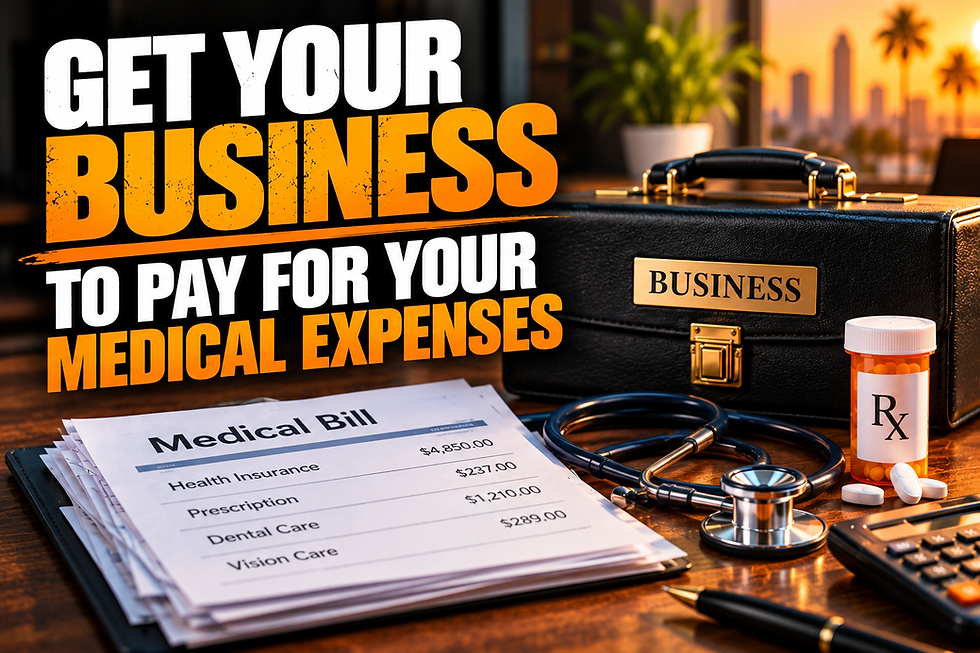
Business owners will spend 30 minutes figuring out whether they can deduct a $47 dinner while writing checks for $10,000, $15,000, or even $20,000 a year in medical expenses out of their personal bank account.
Health insurance. Deductibles. Copays. Prescriptions. Dental work. Glasses.
All paid personally with money you've already paid taxes on.
But depending on how your business is structured, there may be a perfectly legal way for your business to pay or reimburse some of those expenses and receive a tax benefit.
Welcome to another corner of the tax code most entrepreneurs never hear about.
First Question: How Is Your Business Taxed?
A C corporation owner, S corporation owner, LLC owner, sole proprietor and partner don't all play by the same rules.
So the strategy depends on how your business is taxed.
C Corporations: Where Section 105 Gets Interesting
If you operate through a C corporation and legitimately work for the corporation as a W-2 employee, a properly established Section 105 medical reimbursement plan may allow the corporation to reimburse qualifying medical expenses.
Depending on the plan, that could potentially include:
Health insurance premiums
Deductibles and copays
Prescriptions
Dental and vision expenses
Other qualifying medical expenses
The corporation may receive a deduction while qualifying reimbursements may be excluded from the employee's taxable income.
If your family is spending $18,000 a year on healthcare, that's worth paying attention to.
But you can't simply start paying your medical bills from the corporate checking account.
You need the proper plan, documentation and compliance.
Structure first. Spend second.
Have an S Corporation? Different Rules.
If you own more than 2% of an S corporation, you generally can't use an HRA for yourself the same way an ordinary employee can.
But you're not necessarily out of luck.
Your S corporation can generally pay or reimburse your health insurance premiums and report them as required on your W-2. When the requirements are satisfied, you may then qualify for the self-employed health insurance deduction on your personal return.
Important distinction:
We're primarily talking about health insurance premiums here—not automatically turning every deductible, copay and dental bill into a tax-free reimbursement.
And if your LLC elected to be taxed as an S corporation?
You're generally playing by the S-corp rules.
Single-Member LLC or Sole Proprietor?
You're generally not your own employee.
But you may qualify for the self-employed health insurance deduction for premiums covering yourself, your spouse and eligible dependents, subject to the applicable rules.
There's also another strategy worth investigating.
If your spouse legitimately works in the business as a bona fide employee, a properly structured Section 105 spouse-employee plan may create additional opportunities to reimburse qualifying family medical expenses.
And no, having your spouse answer the phone once doesn't suddenly make $20,000 of medical expenses deductible.
We're talking about a real employee doing real work with
Want to Find Out What Else You May Be Missing?
Medical expenses are just one area where business owners may be leaving money on the table.
That's why I created my Tax Deductions List—to show entrepreneurs strategies they should be discussing with their tax professionals.
And if you want to go deeper, you can book a Tax Deduction Evaluation Session, where we'll go through the strategies and identify which ones may apply to your particular business and entity structure.
Don't wait until tax season to discover what you should have done last year.
This article is for educational purposes only and is not legal, tax, accounting, insurance, or financial advice. Health-plan and tax rules are highly dependent on entity type, ownership, employees, plan design and individual circumstances. Consult qualified tax and benefits professionals before implementing any medical reimbursement strategy.

Comments